



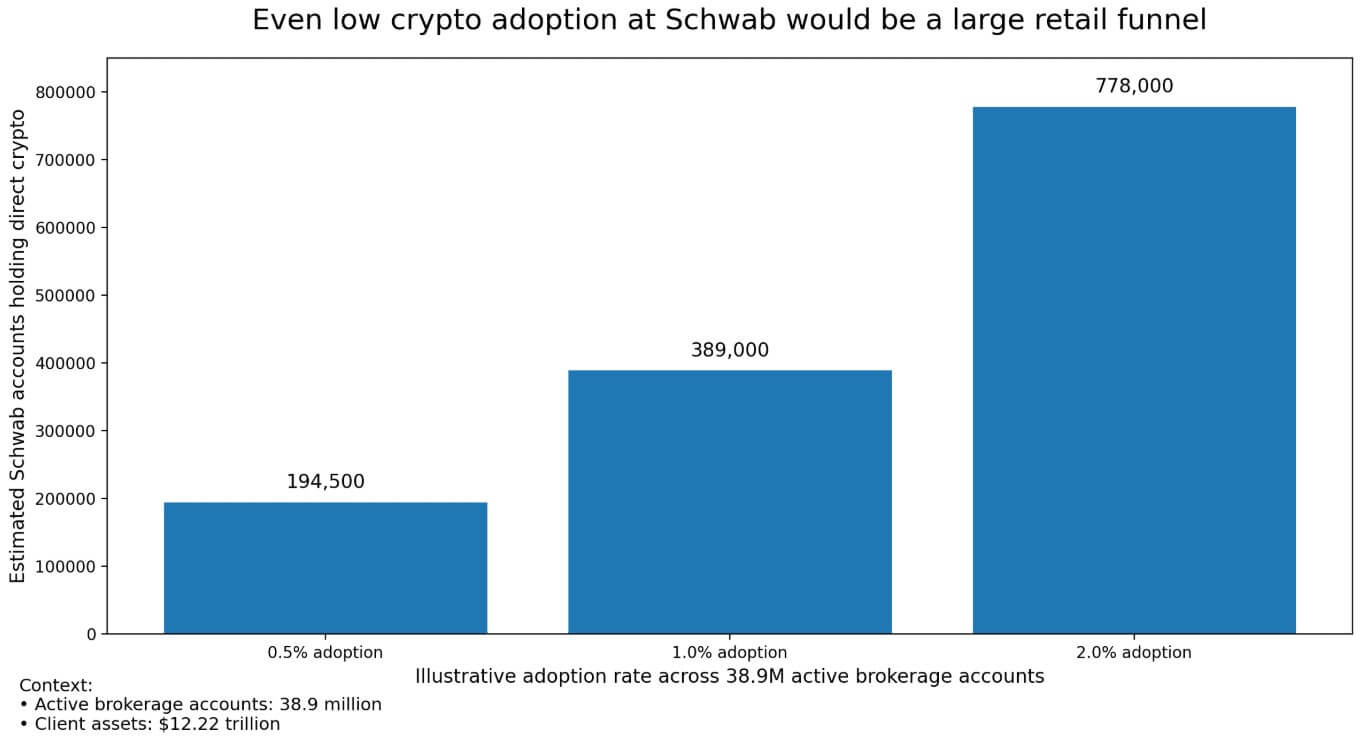
Charles Schwab operates 38.9 million active brokerage accounts and holds $12.22 trillion in client assets. For years, investors in those accounts could reach Bitcoin and Ethereum through ETFs, crypto-related equities, and futures.
A phased launch beginning in the second quarter closes the gap with direct investments. Schwab Crypto, offered through Charles Schwab Premier Bank, SSB, will let qualifying clients buy and sell Bitcoin and Ethereum directly.
The offer is available in all US states except New York and Louisiana, on a timeline that starts with employees and a small initial cohort before broadening.
Why this matters: Schwab is not introducing crypto to a crypto-native audience. It is testing whether direct Bitcoin and Ethereum ownership can sit inside the workflow of a mainstream brokerage customer. If that model gains traction, the implications reach beyond Schwab to product design, broker competition, and the next layer of retail crypto adoption.
The product architecture includes a structural boundary that clients and operators will immediately feel. Schwab Crypto operates through a dedicated account with an affiliated bank subsidiary.
This means that the structure is in a separate account from the brokerage accounts where investors already hold stocks, bonds, and ETFs. The crypto assets carry no SIPC or FDIC protection.
Schwab currently accepts no crypto deposits and does not settle securities or futures transactions in crypto. Mainstream access is real, and it arrives on carefully controlled broker-defined terms.
What drove the timing into 2026 is a policy calendar that dissolved three major institutional frictions within four months.
In January 2025, SAB 122 rescinded the earlier SAB 121 crypto safeguarding guidance that had made custody economics unattractive for traditional banks.

In March 2025, the OCC reaffirmed that crypto custody, certain stablecoin activities, and participation in distributed ledgers are permissible for national banks and removed the supervisory nonobjection requirement.
In April 2025, the Federal Reserve withdrew its earlier crypto guidance and moved to supervise those activities through the standard process.
Schwab CEO Rick Wurster described those regulatory moves as “pretty green” for large firms to expand into crypto, and the launch’s timing confirms how directly the policy calendar shaped the product calendar.
| Date | Regulatory / market development | Why it mattered to Schwab |
|---|---|---|
| January 2025 | SAB 122 rescinded SAB 121 | Reduced a key accounting friction around crypto custody |
| March 2025 | OCC said crypto custody, certain stablecoin activity, and DLT participation are permissible; removed supervisory nonobjection requirement | Made bank-linked crypto activity easier to pursue |
| April 2025 | Federal Reserve withdrew earlier crypto guidance and moved to normal supervision | Reduced special-process friction for large institutions |
| March 2026 | Schwab research said Bitcoin had matured into a mainstream asset | Showed internal positioning had shifted toward normalization |
| Q2 2026 | Schwab began phased crypto rollout | Product timing followed the policy shift |
The asset Schwab is normalizing
In March 2026, Schwab published research describing Bitcoin as having matured into a mainstream asset and noting that by some measures it had become less volatile than certain Magnificent 7 stocks.
The research reflects the internal positioning that led to direct trading as the natural next step.
Reuters reported Wurster’s view that the target user is an investor who already owns stocks and bonds and wants to hold a small slice of Bitcoin or Ethereum alongside those positions.
That is a narrower and more defensible market than the speculative base that drove 2021 volumes. Schwab is building a product for the mainstream investor who already trusts the brokerage brand and wants direct exposure within the brokerage environment they use.

Schwab enters a market that Fidelity already occupies. Fidelity’s crypto account lets customers buy, sell, and transfer crypto through its platform and the Fidelity app alongside their existing brokerage positions.
E*TRADE has published a coming-soon page for direct trading in Bitcoin, Ethereum, and Solana, and reports point to Morgan Stanley plans to run that service through Zerohash in the first half of 2026.
Schwab enters this race as the scale normalizer, being the firm whose distribution footprint turns a multi-broker pattern into an industry default.
When Fidelity launched direct crypto, the market could read it as one firm’s idiosyncratic call.
When Schwab, Fidelity, and E*TRADE each offer some version of direct BTC and ETH access, the mental category moves. When Schwab, Fidelity, and E*TRADE each offer some form of direct BTC and ETH access, direct crypto ownership sits on the same mental shelf as any other optional asset sleeve in a diversified brokerage account.
Schwab’s own site already markets crypto exposure “from a brand you know,” and the launch extends that branding promise from wrappers to the asset itself.
A distribution thought experiment frames the scale without overclaiming a price surge.
If 0.5% of Schwab’s 38.9 million accounts eventually hold direct crypto, that equals roughly 194,500 accounts. At 1%, it becomes approximately 389,000, and at 2% adoption, that funnel reaches roughly 778,000 accounts.
Two paths from here
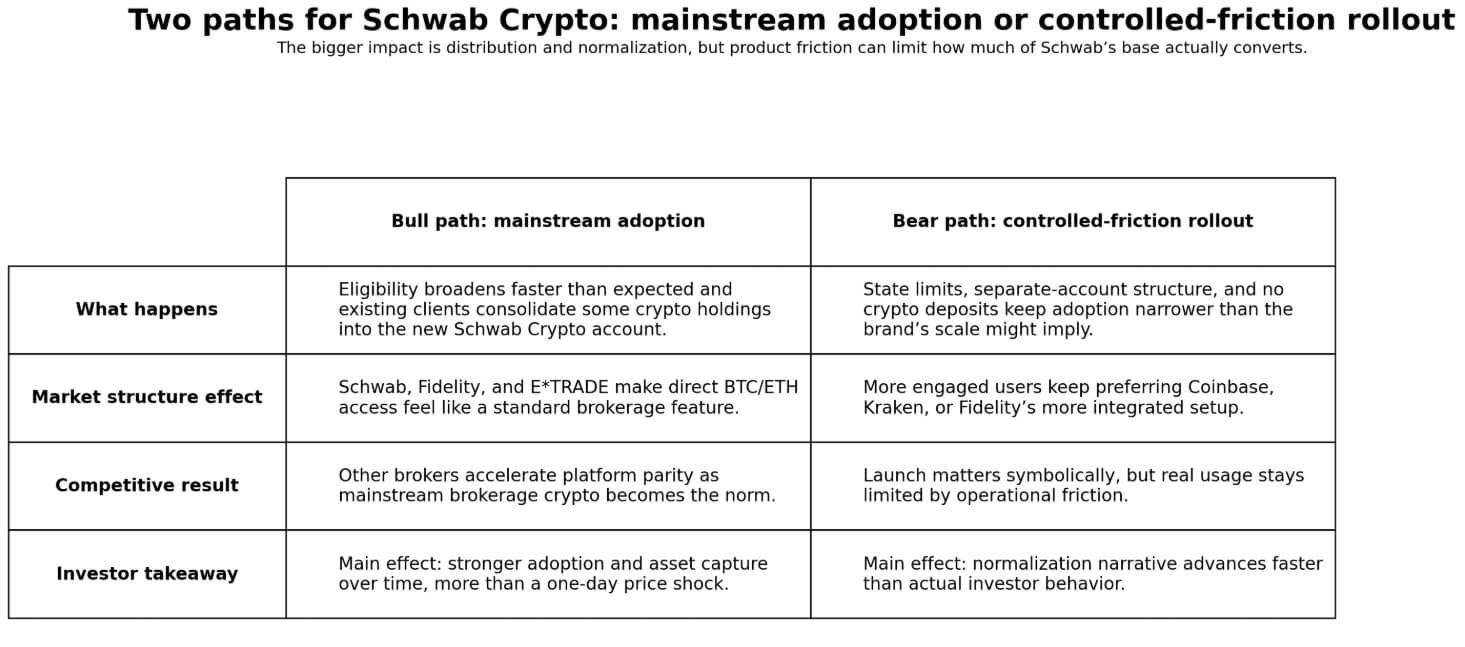
The bull path opens if Schwab broadens eligibility faster than the phased language implies, and if the product experience proves clean enough for existing clients to consolidate crypto holdings into the new account.
In that scenario, Fidelity, E*TRADE, and Schwab together create a demand flywheel within the mainstream brokerage channel, the kind of end-investor adoption that Citi cited in its bull case of $165,000 for Bitcoin and $4,488 for Ethereum.
Schwab’s distribution footprint alone would push every broker that still routes crypto clients exclusively to ETFs or education pages to accelerate its own platform-parity timeline.
The bear path runs through friction. The Schwab Crypto account’s state restrictions, bank-subsidiary architecture, absence of crypto deposits, and current transfer limitations each create gaps relative to crypto-native venues that more engaged users will notice.
If those frictions keep adoption narrow and investors who want direct crypto exposure continue to prefer Coinbase, Kraken, or Fidelity’s more integrated setup, the launch reads as operationally thin.
An investor who wants crypto to sit alongside equities within a single operational view may find the bank-subsidiary rail an exposure vehicle with tighter product boundaries than the brand’s integrated-portfolio framing implies.
The next readable data point arrives when Schwab discloses how quickly the initial second-quarter cohort converts and if the broader rollout accelerates on schedule.
How quickly Schwab moves this cohort to general availability will tell the market whether this launch is a genuine scale ambition or a carefully managed compliance exercise.
The post Charles Schwab’s Bitcoin and Ethereum rollout shows crypto is moving deeper into mainstream brokerage accounts appeared first on CryptoSlate.
About the Author